Lönetracker
A web app for hourly-paid retail workers in Sweden. Upload the schedule, get what the month actually pays — OB supplements, tax and net pay, with every hour attributed to the rule that paid for it.
Someone on a monthly salary roughly knows what lands in their account. Someone paid by the hour, on a schedule that shifts week to week with OB spread unevenly across it, does not. That second group — part-time store staff, which is most of Swedish retail — is who this is for.
A schedule gets in three ways, because every employer runs a different scheduling system: a .csv or .xlsx export, text pasted from a PDF or an email, or shifts typed in by hand. Columns are matched by their headings in Swedish or English, and an unfamiliar file is not rejected — the columns are listed with sample values so the user can point out which is the date, the start and the end.
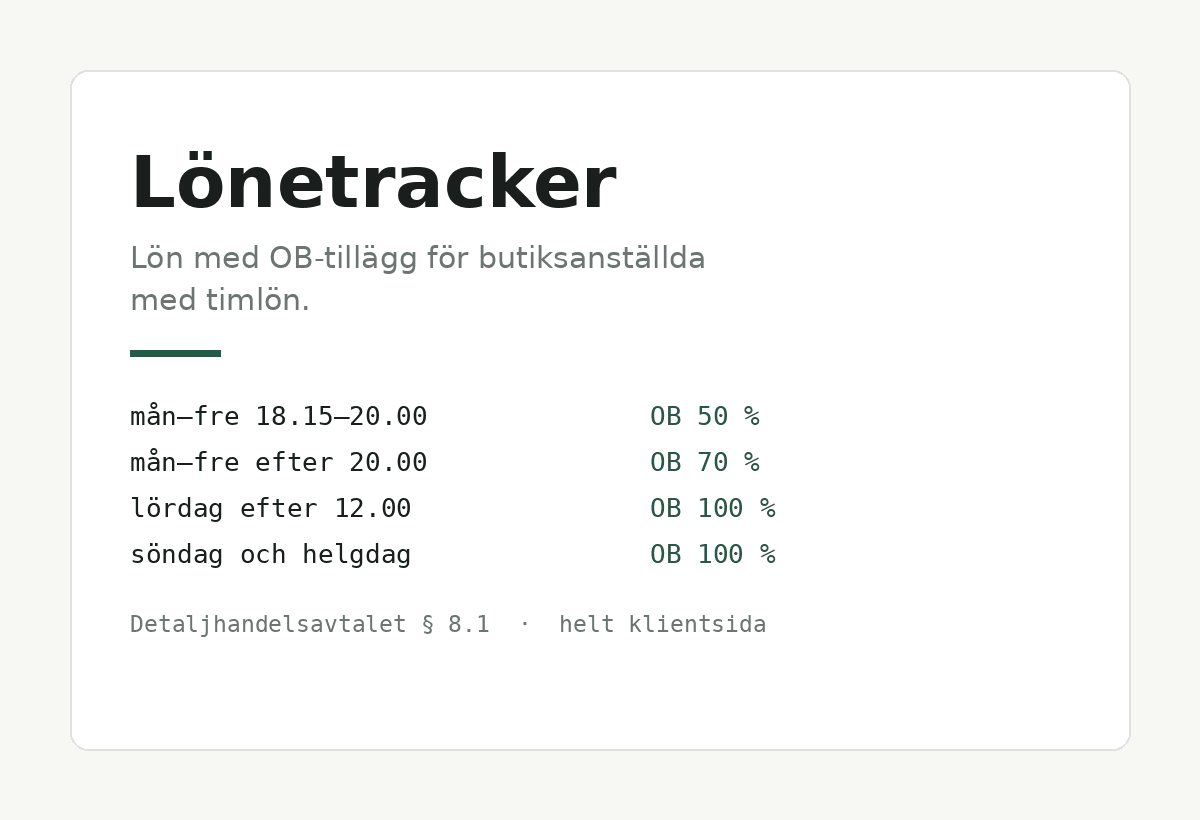
Every shift is split across OB tiers by day type and time of day, taken verbatim from section 8.1 of Detaljhandelsavtalet. Shifts running past midnight get the next day rules for the hours after 00:00; Swedish public holidays are computed per year, including the Easter-derived ones. Breaks are deducted proportionally across tiers rather than off the end, so they do not silently eat the best-paid hours. Sick pay and holiday pay are handled separately, and where the agreement cannot be modelled honestly the app says so rather than guessing.
The rules are data, not code: a rule set is a list of tiers and time windows, so a different agreement or a local addition can be entered by hand. Checked against two real time exports and the payslips they produced, landing within 1.30 kr on the month with every OB tier exact.
There is no backend, no account and no analytics — the schedule is parsed in the browser and the results never leave it. Colleagues use it. The .xlsx reader is hand-rolled, walking the zip central directory and inflating entries with the browser built-in DecompressionStream, so the app ships no spreadsheet dependency.